
The project ‘TARGETED BIOMARKER DEVELOPMENT FOR AMYOTROPHIC LATERAL SCLEROSIS’ was selected for the Fund for Translational Biomedical Research. The project develops mechanism-based biomarkers for ALS.
About the Fund for Translational Biomedical Research
The Biomedical Sciences Group established a Fund for Translational Biomedical Research (FTBO). The fund provides an annual grant to support clinicians and basic researchers, enabling them to further study the clinical applications of findings from basic research. An advisory board chaired by the research coordinator of the Biomedical Sciences Group evaluated the submitted projects.
One project selected
On the advice of the Board, the Group Board selected one project that will be awarded a budget of 80,000 euros for three years – a total of 240,000 euros: ‘TARGETED BIOMARKER DEVELOPMENT FOR AMYOTROPHIC LATERAL SCLEROSIS’. The supervisors are Professors Sandrine Da Cruz, Koen Poesen, Philip Van Damme, and Ludo Van Den Bosch.
Targeted biomarker development for ALS
Amyotrophic lateral sclerosis (ALS) is a serious and rapidly progressing disease in which motor nerve cells slowly die off. Despite significant progress in research, there is still a major lack of good biomarkers. These are measurable substances that can indicate exactly what is going wrong in the body.
The biomarkers we use today, such as neurofilaments, do show that nerve cells are damaged, but they do not reveal which processes within the cells are malfunctioning. As a result, it becomes more difficult to develop treatments that target precisely the right mechanism.

Spatial transcriptomics of human spinal cord samples identifies all expected cell types of the central nervous system based on gene expression profiles of 266 genes. Each dot represents a single cell. The samples include both pathologically normal donors and individuals with ALS.
What does this project aim to do?
The project aims to discover new biomarkers that better reflect which disease
mechanisms are active in ALS. To achieve this, researchers use various types of data. They work with stem cell models (iPSCs) that mimic human nerve cells, with transgenic mouse models in which ALS-related changes have been incorporated, and with advanced analyses of human brain tissue after death. In addition, a biobank containing blood and cerebrospinal fluid samples from ALS patients is used.
By combining these diverse sources of information — such as data on gene activity, proteins, and spatial tissue data — the researchers look for substances typical of specific cell types or for cellular processes that become disrupted in ALS.
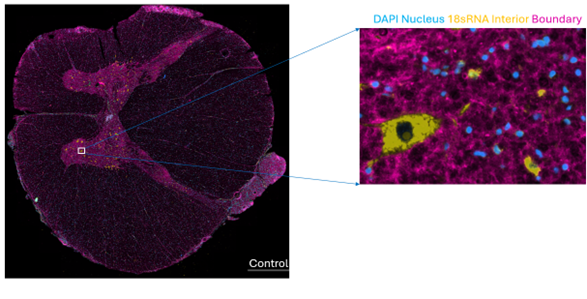
Representative cross-section of the human spinal cord analyzed using Xenium spatial transcriptomics. The non-dissociative protocol preserves tissue architecture and rare cell types, including motor neurons (see zoomed-in inset). The stains are shown as indicated.
What is being developed?
The project will develop a sensitive biomarker panel that maps multiple key disease mechanisms. This includes, among other things, problems with transport within nerve cells, disruptions in protein clearance and processing (proteostasis), inflammatory processes in the nervous system, and problems in supporting cells such as oligodendrocytes.
This biomarker panel can contribute to a faster and more accurate diagnosis of ALS. Additionally, it can help subdivide patients into more recognizable subgroups and monitor whether a treatment is actually effective.
Who is working on it?
By utilizing the combined expertise within the LEUCALS consortium — ranging from clinical neurology, neurobiology, and clinical biomarker development — this project brings together the complementary knowledge of Professors Sandrine Da Cruz, Koen Poesen, Philip Van Damme, and Ludo Van Den Bosch.
This integrated approach creates a unique opportunity to purposefully translate mechanistic insights into clinically applicable tools, thereby accelerating the development of precision medicine for ALS.
Translation: Gerda Eynatten-Bové
Source: website KU Leuven – Biomedical Sciences Group